There is a quiet, invisible weight we carry through our days. We live our lives in a perpetual state of bracing for impact.
If you observe the subtle geometry of human interaction, you will notice a tragedy playing out in the physical posture of the people around you. It happens the moment we encounter power, authority, or friction. The shoulders round forward. The breath becomes shallow. We instinctively shrink to make ourselves smaller, safer, and less exposed.
It is a conditioning so deep we no longer even recognise it as a choice. We see it in the brilliant young mind who lowers their gaze before a professor, quietly compressing their own intellect into clerical subservience, terrified to challenge the gatekeeper of their future. We see it in the ordinary citizen who stands before a public servant, folding their hands and bowing their head to a system they themselves empower—mistaking a constitutional democracy for a feudal court where the Mai-Baap must be appeased. We even breed this into the quiet corners of our own homes, teaching our children that obedience is far safer than a respectfully articulated truth.
We have been structurally trained to believe that survival requires shrinking.
Let us be clear: human civilisation relies on the beautiful, necessary mechanics of cooperation. But we have suffered a collective illusion. We have confused cooperation with submission. Cooperation is a conscious, willing handshake between sovereign equals. Submission is a psychological tax extracted by fear.
Because we have been taught to submit, we walk through the world with our fists clenched, “trying hard” to endure the heavy demands of the system. And here lies the greatest tragedy: we experience the exhausting, grinding friction of our own compliance, and we mistake it for the natural suffering of life itself. We believe life is inherently a burden, unaware that the burden is actually our own resistance.
But how do we dismantle an architecture of fear that is this deeply ingrained? We cannot fight a whole society at once. We must first isolate the mechanism of fear within our own nervous system.
To understand this, look at the simplest, most primitive friction you can encounter. Imagine standing alone in the quiet of a dark winter morning, just before you step into a freezing shower.
Before the water even touches your skin, your mind has already built a prison of anticipation. Your primitive brain—the exact same apparatus that has been trained to bow to the bureaucrat and fear the professor—is screaming at you. It commands your muscles to tense, your breath to hold, and your mind to suffer the cold before it has even arrived. The friction has already begun.
But what happens in that infinitesimal fraction of a second, just before the water hits, if you simply refuse the command to shrink?
Antidote of Sovereignty
Imagine making a conscious, radical choice. You drop your shoulders. You open your chest. You stand perfectly, uncompromisingly tall. You do not fight the water. You do not try to command it to be warm. You simply allow it to exist, and you observe it.
In that exact moment, a profound psychological transmutation occurs. The temperature of the water has not changed. The objective reality of the hardship remains mathematically identical. Yet, the suffering completely evaporates. It is no longer an assault; it is merely an intense sensation passing over an unbothered mind.
You have ceased to be a victim of your environment. You have become the sovereign observer of it.
We call this quiet, devastatingly powerful override The Swaraji Switch.
To understand the sheer magnitude of this switch, we must look at the mechanics of human exhaustion. When you sit in a social hierarchy and feel the anxiety of judgement, or when you stand before a broken system and feel helpless, you are fighting the room. This is the definition of operating out of Force.
Force is inherently exhausting because it demands that you constantly push against reality to carve out a safe space for yourself. When you operate on Force, you act as a mere thermometer; your internal state violently rises and falls with the temperature of the world around you.
But the moment you drop the resistance—the moment you decide to stop trying to prove your worth to the room, or stop fighting the friction of the system—you shift from Force into Power. You are no longer the thermometer. You become the thermostat. You dictate the internal weather.
But why do we default to Force? Why do we suffer the room in the first place?
We suffer because we have subconsciously handed the deed to our own self-worth over to the people sitting inside it. We have been conditioned to act like anxious tenants in our own minds, constantly hoping the landlord—whether that is society, an institution, or the state—approves of our stay. We wait for the external world to grant us permission to feel secure, to feel valid, to feel heard.
Flipping the Swaraji Switch is the sudden, absolute realisation of your own unalienable psychological rights.
It is the recognition that your self-worth is not a variable to be traded in the marketplace of society; it is a fundamental, constitutional constant. It is not on the table to be negotiated by a flawed system, a failed examination, or the fleeting opinions of mortals.
When you finally realise that your core identity requires no external validation, there is nothing left to protect. The fear simply dissolves. You begin to experience the world fearlessly—not because the world has suddenly become safe, but because you are no longer asking for its permission to exist.
You look at the cold water, the systemic injustice, or the gatekeeper attempting to intimidate you, and you realise the ultimate truth of a sovereign mind: They only have access to my physical senses. They have absolutely zero jurisdiction over my psychological architecture.
The Quite Revolution
This sounds like a magnificent philosophical leap, but philosophy alone will not save you when the heavy friction of reality arrives.
The mind is fragile under pressure. The next time you walk into a room of authority, or face a systemic injustice, or simply wake up to a daunting, exhausting day, your primitive brain will inevitably attempt to hijack you again. It will flood your system with the old conditioning. It will command you to shrink, to brace, and to revert to the safety of the anxious tenant. You cannot simply think your way out of this state, because your thinking apparatus is already compromised by the fear.
This is why the Swaraji Switch cannot just be a mental exercise. It must be anchored in the flesh.
When you feel that heavy, lethargic friction pressing down on you—that familiar, involuntary urge to make yourself smaller—do not try to argue with your own anxiety. Instead, change your physical geometry.
If you are sitting before a gatekeeper, sit up straight. If you are standing before a broken system, plant your feet firmly. Drop your shoulders. Expand your chest. Take the slow, deliberate breath of an owner, not a tenant. By physically adopting the posture of a sovereign individual, your body sends a shockwave back to your brain, forcefully interrupting the primitive fear response. You physically override the system.
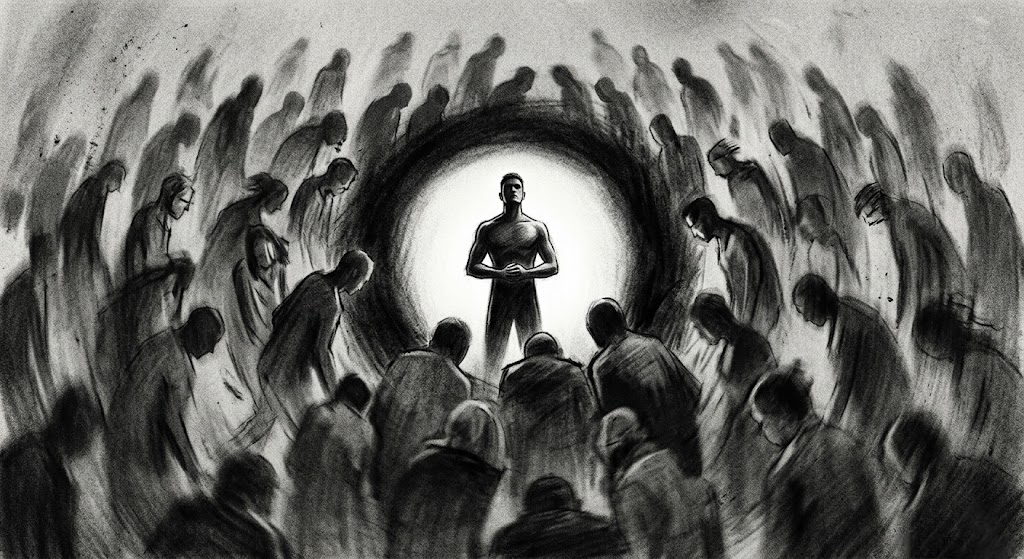
In that newly created space between your posture and your breath, you make the silent declaration: I choose not to fight this reality, but I absolutely refuse to shrink before it.
This is where a deeply personal psychological shift transforms into a quiet, unstoppable civilisational force.
When an individual stops shrinking, the power dynamics of the room immediately alter. You do not need to raise your voice to command respect; a sovereign mind projects a gravity that forces the world to naturally reorganise itself around it.
Now, imagine this at scale. Imagine a nation where the citizen no longer approaches the state with the folded hands of a subject, but with the quiet, unshakeable dignity of the ultimate constitutional authority. Imagine a society where cooperation is no longer extracted through the fear of authority, but offered freely as a handshake between sovereign equals.
A society built on the submission of tenants is fragile, easily manipulated, and perpetually exhausted. But a democracy built on the fearless cooperation of sovereign individuals is entirely unbreakable.
True Swaraj—true self-rule—does not begin in the halls of parliament. It does not begin with tearing down the old world. It begins in the quiet, microscopic space between the cold water and your skin. It begins the moment you reclaim jurisdiction over your own mind.
The world will not lower its temperature for you. The gatekeepers will not voluntarily dismantle their own gates. The friction of life will always remain. But when you finally flip the switch, you will realise the most dangerous, beautiful truth of all:
They no longer have the power to make you shiver.
