
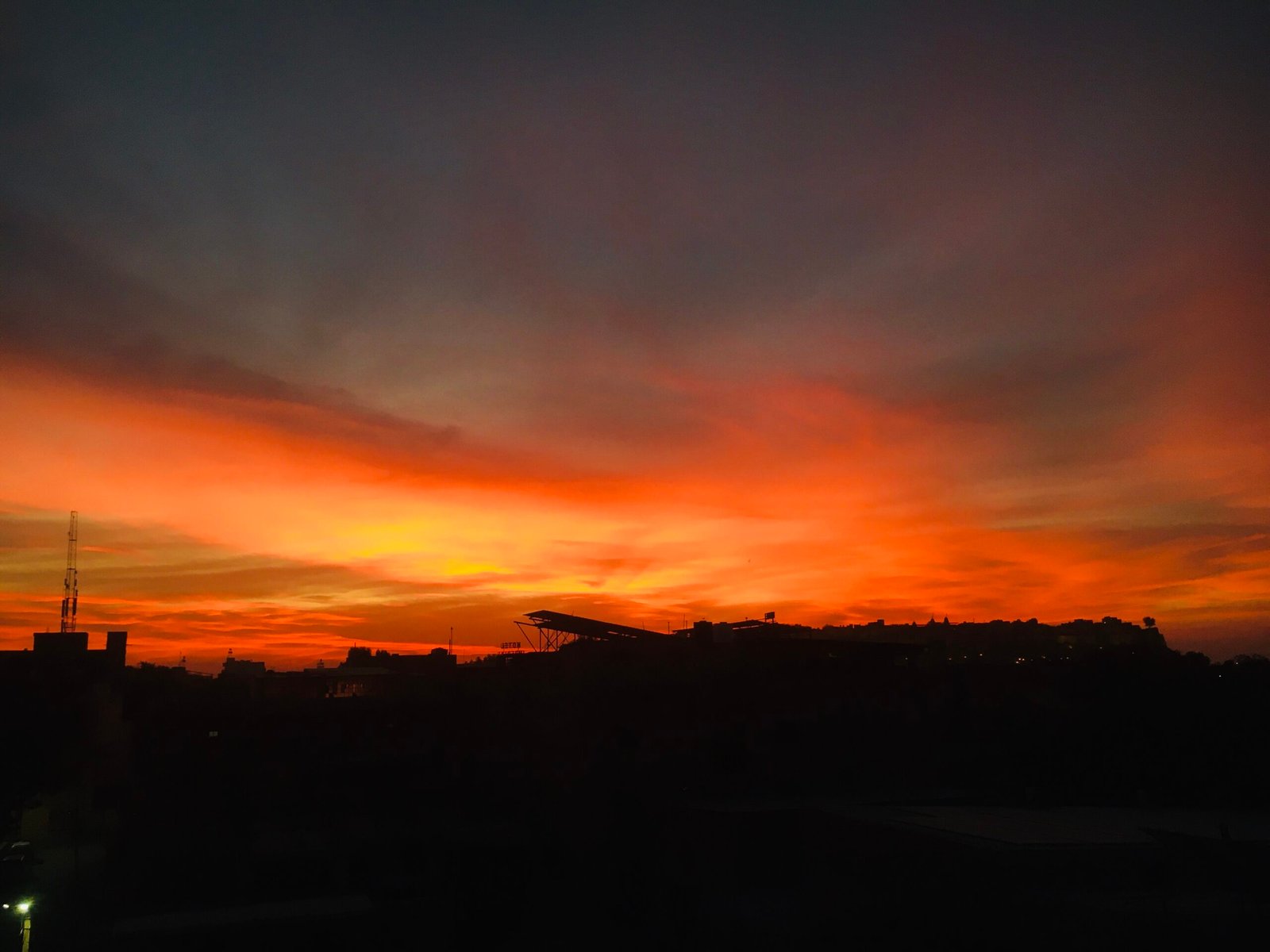
Yesterday, I stood in the silence of a cremation ground.
We were there for the last rites of a friend’s father. You know that specific kind of silence that exists only there? It is a heavy, truthful silence. When the fire begins its work, it doesn’t just dissolve the body; it seems to dissolve the weight of everything we usually carry—the ambitions, the degrees, the rush, the noise of “becoming” someone.
In that pause, a friend standing next to me asked something very quietly. He wasn’t the one grieving, but he was shaken by the sheer finality of it all. He asked about the point of this struggle, this constant running we do.
The answer didn’t come from my intellect. It floated up from somewhere deeper, a realisation that felt as old as the fire itself. I just whispered:
“Life is Experience.”
He looked at me, and we didn’t say much after that. But that sentence stayed with me. It followed me home.
Later, I sat down and looked at some pictures from my own journey.
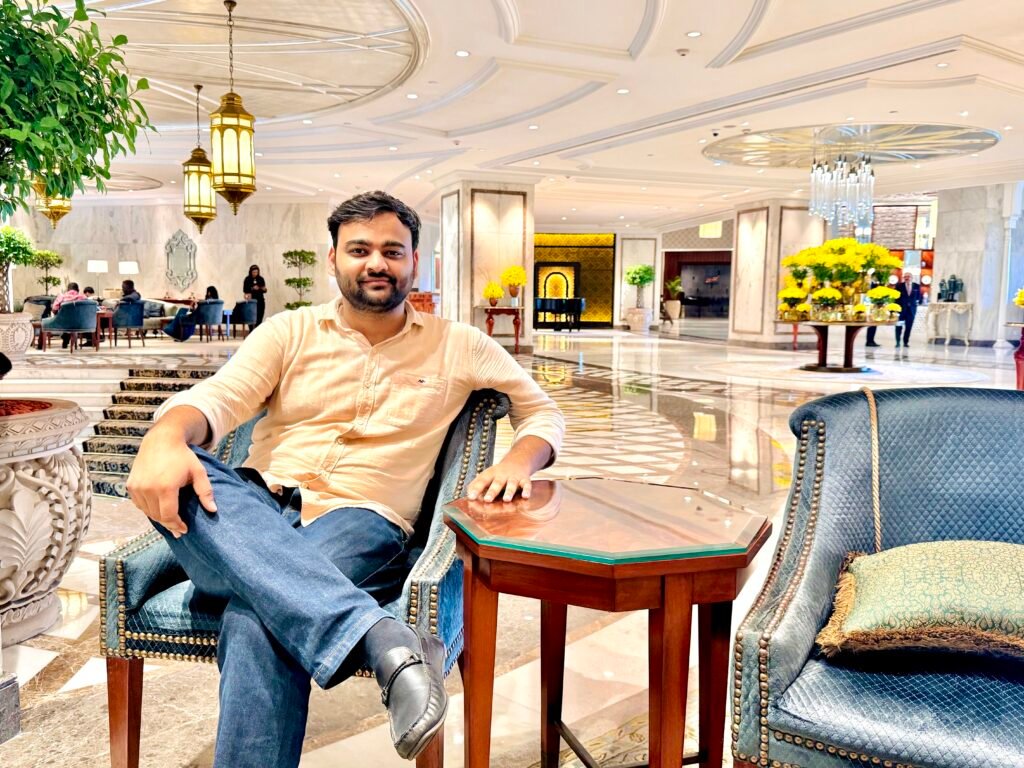
In one, I am in the earlier chapter of my life—the years of the PhD, moving through the urban centers, sitting in places like the Taj. The world around me was polished, the inputs were “premium,” and the air was filled with the electric hum of ambition.
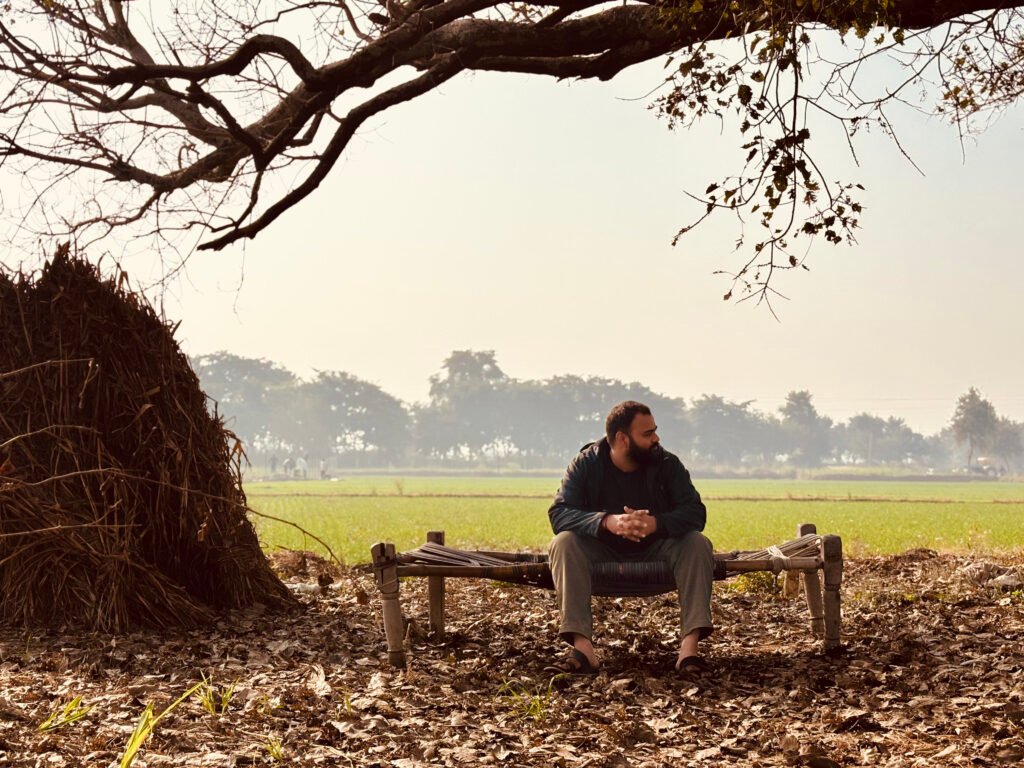
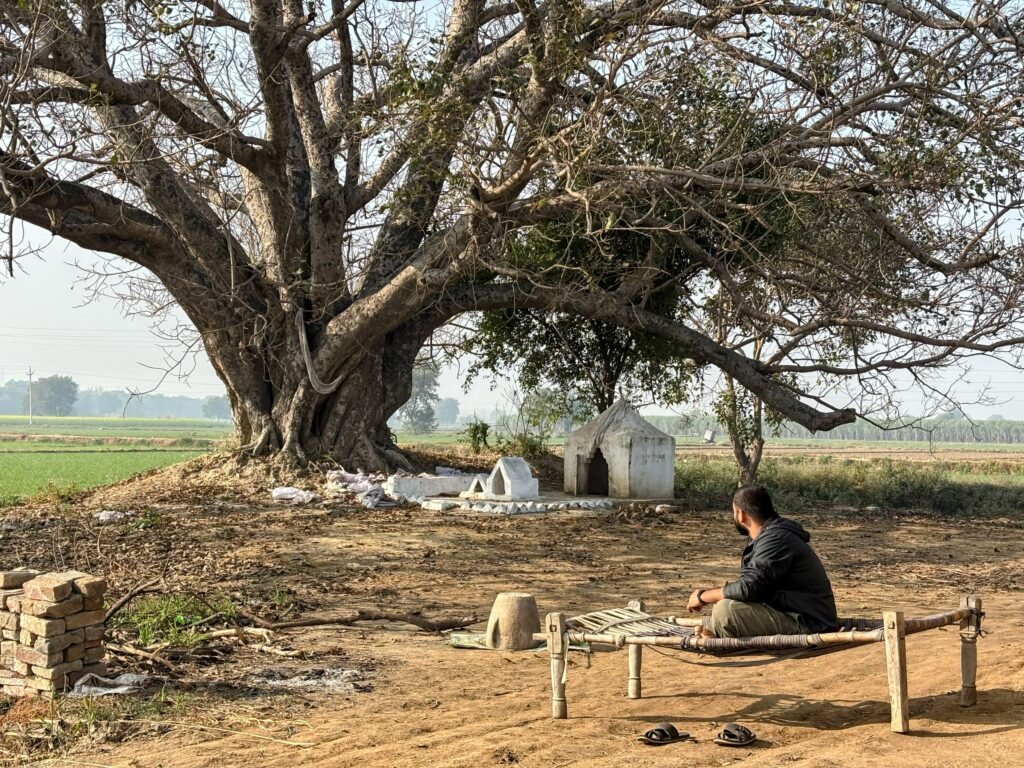
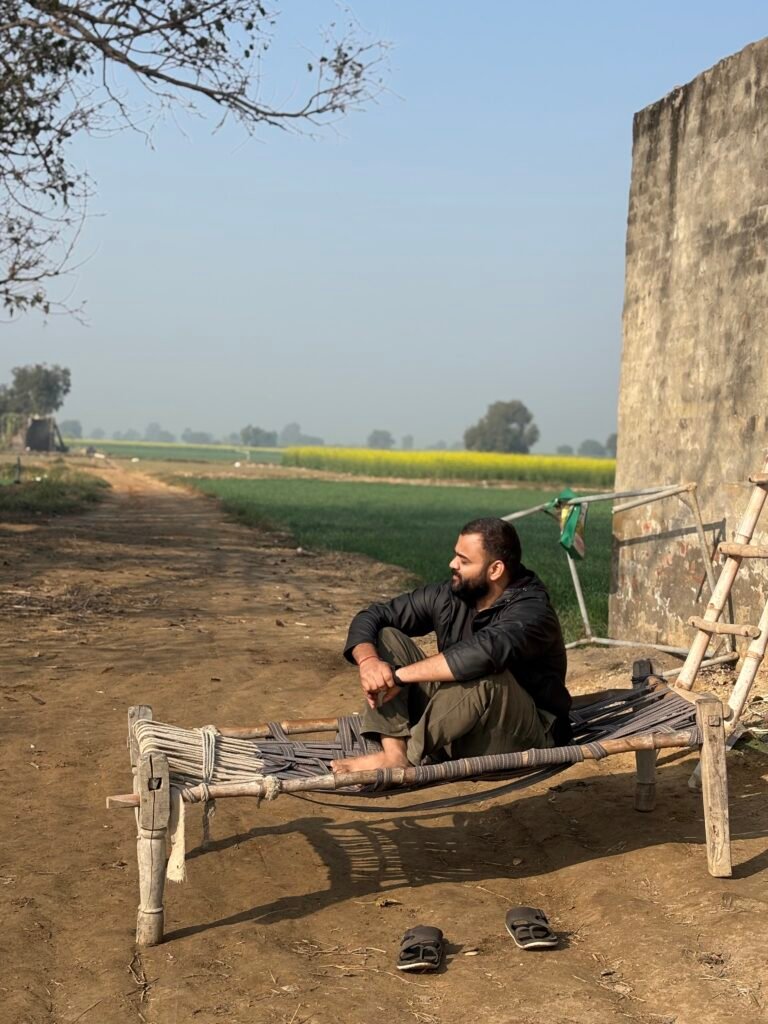
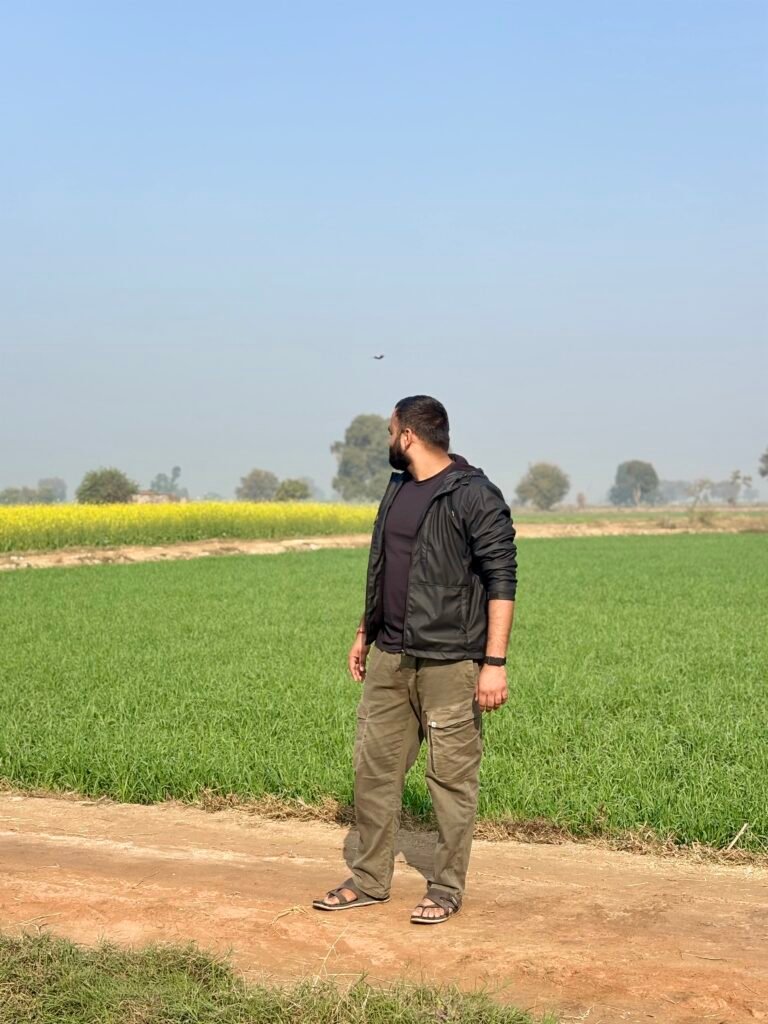
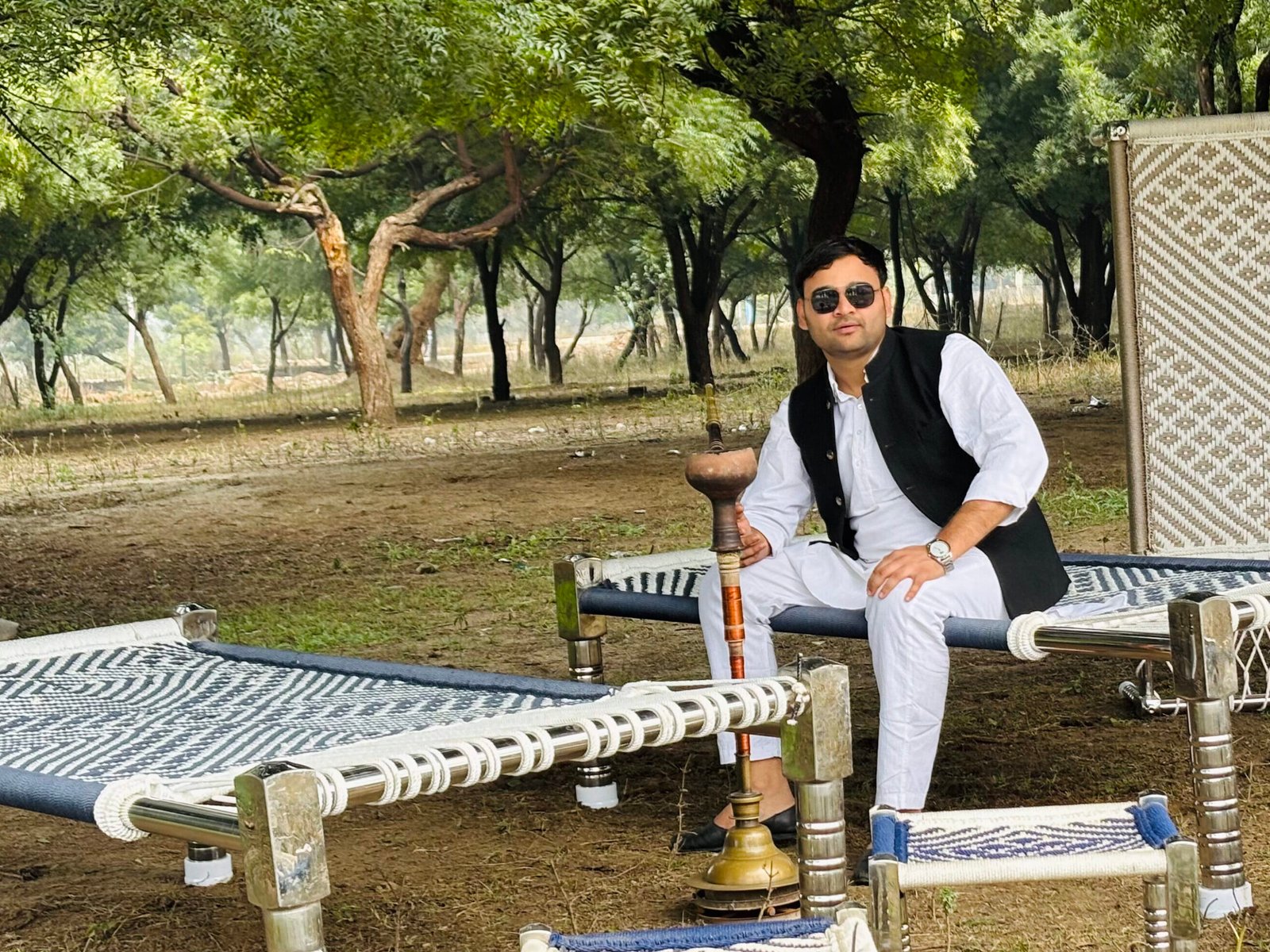
In the other, I am here, where I am now—sitting on a charpai in the fields of my village, surrounded by wheat stalks and the slow, patient rhythm of the soil.
Looking at them side by side, I realised something profound.
It would be easy to tell you that the city was “chaos” and the village is “peace.” But that would be a lie. The truth is much more delicate.
I have known moments of deep, paralysing anxiety while sitting in the quietest fields, where the only sound was the wind. And I have known moments of absolute, stillness and joy while standing in the middle of a crowded city.
I realised that the “Taj” wasn’t a palace of happiness, and the “Field” isn’t a guarantee of peace. They are just containers.
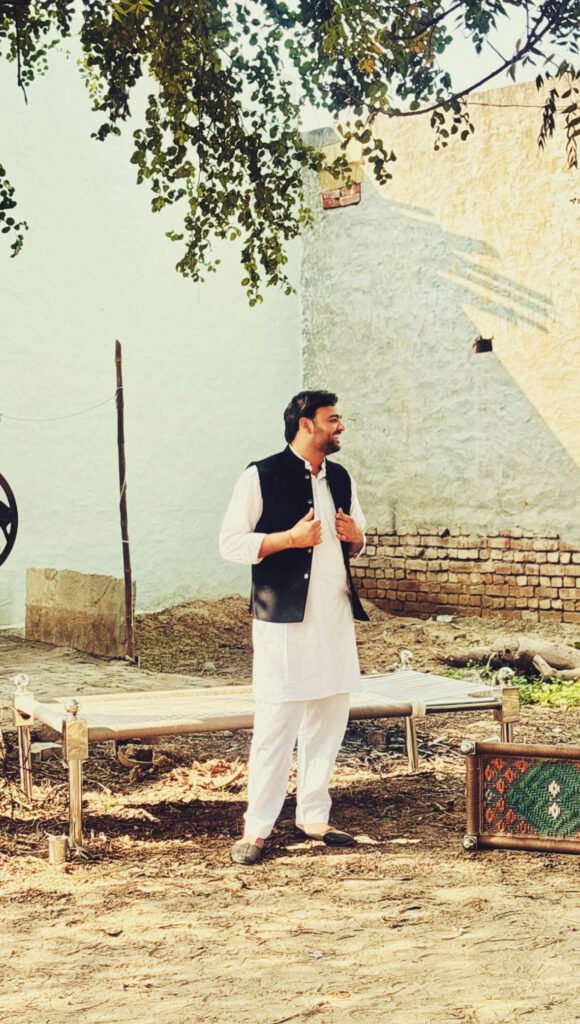
We spend so much of our lives trying to change the container—thinking that if we just move from the struggle to the success, or from the noise to the silence, we will finally be okay. But we rarely look at the water inside the container.
We rarely look at the quality of the experiencing mind.
If the mind is anxious, even the silence of the village feels haunting. If the mind is still, even the noise of the market feels like a rhythm.
So when I said, “Life is Experience,” this is what I meant: The quality of your life isn’t determined by where you are sitting. It is determined by how you are receiving the moment.
This brings me to a thought that has been quietly reshaping how I see the world.
Internal Geography
We are raised on stories of Heaven and Hell as destinations waiting for us after death. The priests and the elders tell us that if we are good, we go to a place of eternal comfort, and if we are bad, we go to a place of eternal fire.
But the more I observe human life—from the high-rises of the city to the courtyards of the village—the more I realise that this is a fairy tale for children.
Heaven and Hell are not places you go to. They are frequencies you live in.
You construct them every single day, brick by brick, with the quality of your own mind.
I have seen men who have “won” at everything—they have the power, the illicit wealth, and the fear of the community—yet they live in a state of absolute, biological hell. You can see it in their eyes. It’s not just ageing; it’s a kind of internal rotting. They have the best doctors and the softest beds, yet they carry a vibration of chronic unease.
Why?
Because the body keeps the score.
Think of your mind as a house with three inhabitants. Psychology calls them the Id (the beast that wants pleasure), the Ego (the manager that deals with the world), and the Superego (the judge that knows right from wrong).
When a man takes a shortcut—a bribe, a lie, an act of deceit—a civil war breaks out in this house.
The Id is happy; it got the money. The Ego is proud; it tricked the world and didn’t get caught. But the Superego—the Witness—was watching.
The tragedy of the corrupt man is that he can hide his crime from the police, he can hide it from his family, but he shares his skull with the Witness. He cannot hide it from himself.
And because the Witness cannot call the police, it does something worse: It attacks the host.
It begins a constant, low-grade “pricking.” We call it guilt, but biologically, it is a cortisol drip. The mind has to run a background process 24/7 to maintain the lie, to keep the stories straight, and to justify the action. This burns up all his psychic energy.
This is the Anatomy of Hell.
Hell is not a pit of fire. Hell is a nervous system that is stuck in “Threat Detection Mode” while sitting on a velvet sofa. It is the inability to switch off. It is the biological impossibility of peace.
The corrupt man has bought the Bed, but he has sold the Sleep.
And the poison doesn’t stop with him. It leaks. I have observed that when a man brings home “poisoned money,” he inevitably brings home a “poisoned culture.” The children watch. They absorb the vibration that winning is more important than being. They learn the shortcuts. And eventually, that same culture of deceit turns against the father. The home becomes a jungle.
On the flip side, I have seen the “Heaven” of the honest man.
He might have less. The “scenery” of his life might be simple. But inside, there is no civil war. His Id, Ego, and Superego are aligned. He has nothing to hide, so he has nothing to fear. His energy isn’t wasted on maintaining a lie; it is free to actually taste his food, to feel the wind, to love his family.
His nervous system is at rest. That is Heaven.
So, what I realised at the cremation ground is actually a warning:
If you trade your “Peace of Mind” for a “Piece of Land,” you have made a foolish bargain. You have upgraded the container, but you have poisoned the water.
The Death of the Clock
And you know, this internal state doesn’t just change how we feel about ourselves. It changes our relationship with the only resource we truly own: Time.
I have always believed in a strange kind of physics. The books say that time is constant—that a minute is always sixty seconds. But the experiencing mind knows that this is false.
In that state of “internal civil war”—when there is friction, guilt, or anxiety—time stretches. It becomes heavy. A single hour of waiting for a result, or fearing an exposure, feels like a lifetime. That is the punishment of the “Hell” state: You are trapped in the dragging seconds of your own misery.
But in the state of alignment—when I am sitting on that charpai, or deep in work that matters—time evaporates. The sun sets, and I don’t even know where the day went.
That is why, for the longest time, I refused to wear a watch.
People thought it was arrogance or carelessness. But for me, it was a rebellion. I didn’t want a machine on my wrist slicing my life into seconds. I didn’t want to be told to “hurry up” by a dial. I wanted to live in the Experience, not in the Schedule.
I wanted the sunset to tell me when to go home, not the hour hand.
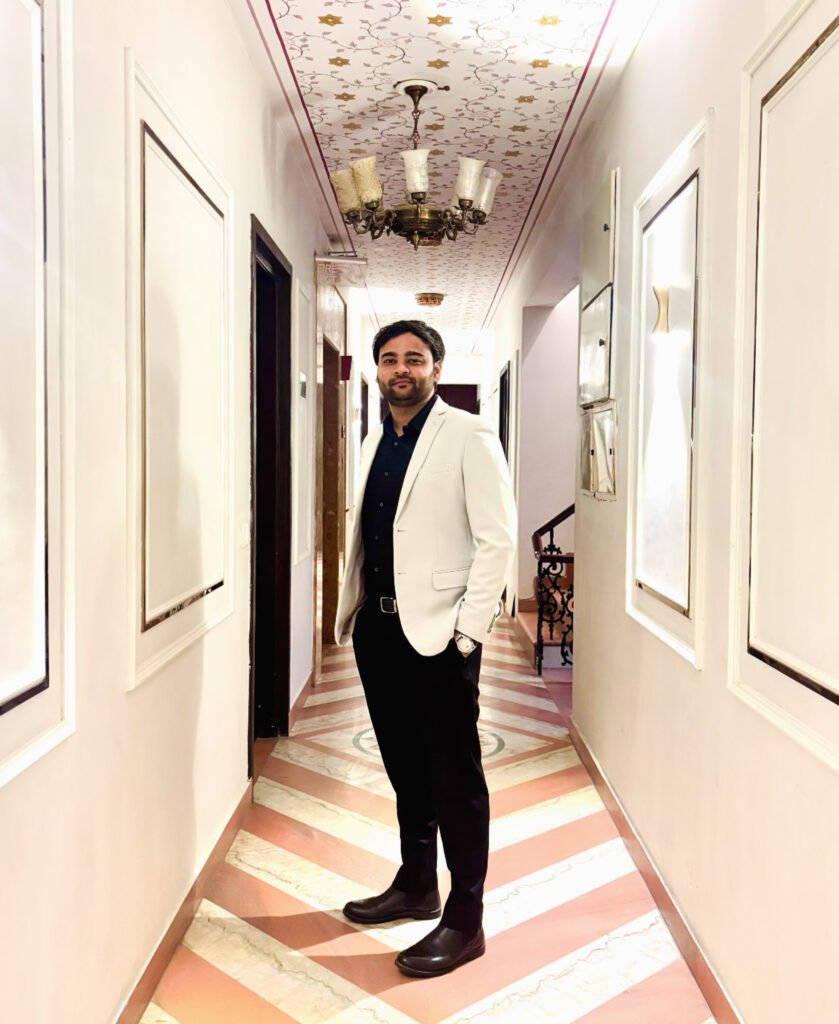
Even today, looking at my wrist, I wear a band, but it has no screen. It doesn’t tell me the time of the world. It stays silent. It only tracks my biology—my sleep, my recovery, my energy.
It is my daily reminder of the shift I am trying to make:
Stop managing the Schedule. Start managing the Energy.
Because if the energy is pure—if the “internal weather” is clear—you don’t need to count the hours. You just live them.
The Selector
There is one last layer to this, perhaps the most critical one.
If we stop counting the seconds, what fills them? The answer is Attention.
I’ve come to realise that we don’t just “have” an experience. We select it.
Think back to that image of the Taj Hotel. You can stand in the middle of the most magnificent palace in the world, surrounded by art and history. But if your attention is fixated on a small, dirty stain on the carpet, what is your experience in that moment? Your entire universe is just a dirty carpet. The palace ceases to exist because you are not attending to it.
This is the tragedy of the “Anxious Mind” or the “Guilty Mind” we talked about earlier.
The man who lives in the “Hell” of internal friction has a broken selector. Because his nervous system is in survival mode, his attention has a Negativity Bias. He walks into a room and automatically scans for threats, for judgment, for flaws. He is incapable of seeing beauty because his survival instinct tells him that beauty is useless, while threats are fatal.
He scans the world for enemies, and so, the world becomes a hostile place.
I used to think that “Experience” was what happened to me. Now I know that “Experience” is what I choose to attend to.
If the mind is pure—if the “Civil War” has ended—the selector becomes free. You can choose to look at the wheat stalk instead of the dust. You can choose to hear the bird instead of the traffic.
If your selector is broken, your life is broken. No amount of money can fix a mind that is obsessed with the stain on the carpet.
The World is a Mirror
And this leads to the final truth, the one that the ancients knew long before psychology existed.
In our philosophy, there is a concept called Drishti-Srishti Vada. It means, simply: “As is your Vision (Drishti), so is the World (Srishti).”
We grow up believing that the world is “out there,” solid and fixed, and that we are just small observers walking through it. But the truth is the opposite. The world is a mirror. It doesn’t dictate what you see; it reflects who you are.
If I wear red glasses, the whole world turns red. I can travel to the Alps, to the Taj Mahal, or to the moon, but as long as those glasses are on my face, everything will look red. I can scream at the mountains for being red, I can try to paint them blue, but nothing will change until I take off the glasses.
If you wear “Greed” glasses, the world looks like a market to be exploited. Everyone is a customer or a competitor. If you wear “Fear” glasses, the world looks like a trap. Everyone is a threat. But if you wear “Gratitude” glasses, the world looks like a gift.
The Swaraji understands that changing the world is hard, often impossible. But changing the glasses? That is entirely within our control.
So, the realisation I found at the cremation ground is the truth I am now carrying with me.
I realised that the laborer sleeping soundly on the hard earth, fully surrendered to the rest, is wealthier in that moment than the Emperor tossing on his velvet bed, fearing a coup.
The Emperor has the “Standard of Living.” The Laborer has the “Quality of Life.”
We spend our whole lives trying to become the Emperor. We build the palace, we fight the wars, we gather the gold. But if in the process, we shatter the lens—if we fill our minds with suspicion, guilt, and noise—we end up as prisoners in our own palace.
My friend, the richest man is not the one with the most inputs. He is the one with the deepest capacity to receive them.
So let the Emperors keep their palaces. You keep your peace.
Because in the end, the only Kingdom that matters is the one inside your chest.
