
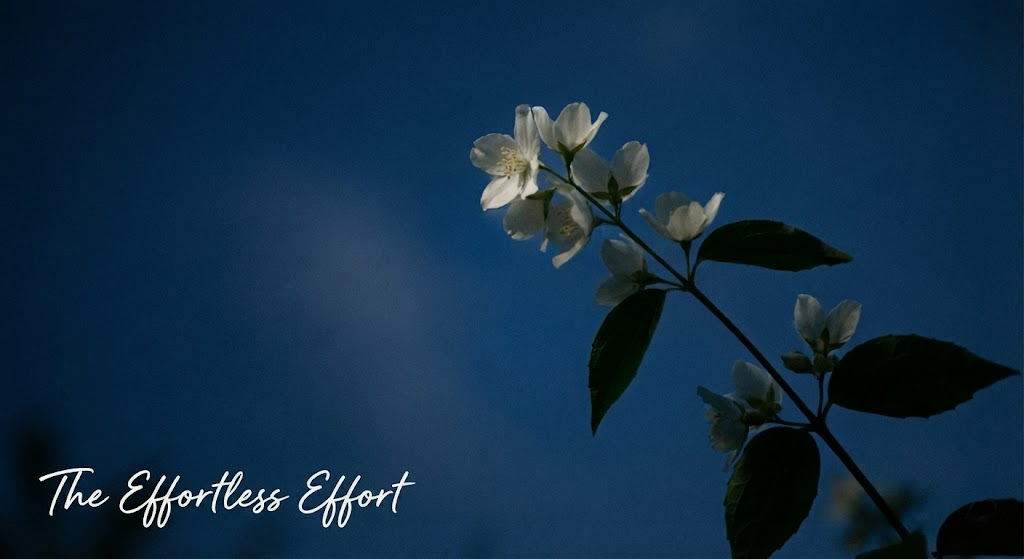
Have you ever walked past a Jasmine bush (Raat-ki-Rani) in the deep quiet of the night?
It does not stand there trying to be fragrant. It does not follow a rulebook that commands it to scent the air at 8:00 PM. It does not look around anxiously to see if anyone is appreciating its effort, nor does it judge the thorns growing on the wild bush next to it. It simply is Jasmine. The fragrance is not its labour; the fragrance is its nature. It happens effortlessly, inevitably, simply because its roots have touched the water.
But we, the exhausted travellers of the human experience, often live very differently.
There is a fatigue that many of us carry, a heaviness that has nothing to do with the work of our hands and everything to do with the work of our image. We spend our lives trying to be “Good.” We read the scriptures and books on kindness, we follow the codes of our faith, we look at the lives of the Saints, and we see the beautiful fruits of their existence—their endless patience, their inability to lie, their overflowing charity.
In our innocent longing to be like them, we make a heartbreaking mistake: we try to mimic their ending without ever walking their beginning. We try to reverse-engineer sanctity. We see their Fruit, and we think the Fruit is the goal. So, we pick up the plastic fruits of “Politeness,” “Morality,” “Modesty” and “Kindness,” and we try to glue them onto our own dry branches. We try to force our behaviour to match a code, while our hearts are still trembling with the same old fears and desires, believing that if we act the part long enough, we will eventually become the role.
But the soul knows the difference between a flower and a painting of a flower.
The tragedy of this approach is not just that it fails, but that it is violently expensive to our life force. When you try to reach the destination of Goodness directly from the station of Ignorance, bypassing the journey of Transformation, you create a state of internal war.
Consider the sheer physics of it. When you feel a surge of anger rising within you, but your moral code demands that you smile and speak softly, you are not creating peace; you are creating friction. You are engaging in a silent, internal war. You are using half your vital energy to suppress the storm raging inside you, and the other half to project a calm that you do not feel. You are burning twice the fuel to remain in the same place.
This cognitive dissonance—this silent hypocrisy— is the great energy leak of the moral life. We become the custodians of a museum, constantly polishing the glass cases of our character, terrified that if we stop for even a moment, the raw, untamed reality of who we are will break through. We are not flowing; we are forcing. And this force slowly chars the spirit, leaving us hollow, brittle, and secretly resentful of the very virtues we try to uphold.
This is why we see so much “religious materialism” in the world. We see people who follow every ritual and speak every scripture, yet their presence feels cold and transactional. They are exhausted soldiers of morality, carrying the heavy armour of righteousness, waiting for a reward that never comes.
But a quiet question arises: Does this mean we should stop trying? Should we wait to be perfect before we act kind?
No. But we must understand the profound difference between Practice and Pretence.
Think of a musician learning to play the sitar. He plays the scales over and over—it is repetitive, it is difficult, and it is not yet music. But he does it to train his fingers. This is Practice. It is honest work. Now, think of a man on a stage holding a sitar and moving his hands to a pre-recorded track, pretending to be a maestro. This is Pretence. It is a lie.
When you force yourself to smile at a difficult neighbour because you are training your heart to stretch, you are the Musician practicing his scales. You are honest about the effort. But when you smile at him only so he thinks you are a saint, you are the Mime. Practice transforms the heart; Pretence merely paints the face. We are asked to practice, not to perform.
And what of the rules? Does this mean that the codes of our faiths and societies are useless?
No. But we have misunderstood their purpose. A gardener puts a fence around a young sapling to protect it from the wild animals. The fence is necessary. The fence is the discipline; the fence is the moral code. But the gardener never confuses the fence with the flower. He knows that no matter how strong or beautiful the fence is, the fence cannot grow. Only the life inside can grow.
We have spent centuries worshipping the fence while neglecting the sapling. We have perfected our discipline but starved our souls.
But the Jasmine does not force. And neither did the Sage. So there is another way. It’s the path of the river, not the rock.
The great secret that we have never realised is that the Saint never tries to be good. The Sage never practices compassion or non-violence. They have simply undergone a shift in the very seat of their consciousness. They have travelled from the darkness of separation to the light of Oneness. When a being truly realises—in the very marrow of their bones—that they and the world are not two, but One, hurting another becomes as impossible as biting one’s own tongue.
They don’t force themselves to be generous; their hands open on their own because they know they own nothing. They don’t force themselves to be truthful; lies simply taste bitter on their tongue.
Their kindness is not a duty; it is a reflex. It is the inevitable side-effect of their internal revolution. They tended to the Roots—the invisible, silent connection to the Divine—and the behaviour took care of itself.
They travelled from Ignorance to Realisation—from the darkness to the light—and the “Good Behaviour” that society worships was merely the footprint they left behind. They were never concerned with the footprint; they were only concerned with the walking.
But do not mistake this natural blooming for laziness. Do not think that because the Jasmine’s scent is effortless, its life is passive.
Roots do not rest. In the dark, beneath the surface where no one sees, the roots are engaged in a fierce, relentless industry. They push through hard rocks, they search desperately for water, they anchor the plant against the wind.
To rely on the internal shift does not mean we sit with folded hands and wait for enlightenment to strike us like lightning. It means we work harder, but in a different place. We do not stop helping the poor or speaking the truth because we are “not ready.” We let our hands work in the world, while our hearts dig furiously in the silence. The flower may be still, but the roots are always travelling.
When we understand this, the heavy armour falls from our shoulders. A profound relief washes over the soul. We realise that we are not required to act holy; we are only invited to be true.
We can stop the exhausting business of managing our image. We can stop wasting our precious life force on suppression and pretence. Instead, we can pour that energy into the roots. This does not mean we abandon discipline, but we change its motive. We no longer use discipline to suppress our darkness; we use it to create space for the light. We can turn our attention inward, not to judge our darkness, but to understand it, to bring the light of awareness to the knots of our own ignorance. We can move from the exhausting effort of “doing” good to the silent, transformative power of “seeing” truth.
And the most beautiful part of this blooming is that it leaves no room for pride. The Jasmine is not proud of its scent, for it knows the scent belongs to the soil and the rain, not to the bush. Similarly, when your goodness flows from this deep internal shift,—when the heart truly opens, not because it was told to, but because it has seen the light—the goodness that emerges is effortless. It has no weight. It demands no credit. It casts no shadow. You are never proud of it. You do not look down on those who are angry or lost, for you remember the fire. You realise that your virtue is not your achievement; it is simply the nature of the peace flowing through a channel that is finally clear.
This is the beauty of the authentic life. It is not a forced march towards a moral ideal, but a gentle unfolding of the divine already resting within.
So, let us put down the burden of trying to be good. Let us stop the exhausting work of polishing the leaves while the roots are dry. Let us turn our attention inward. Let us water the roots with silence, with understanding, with the search for Truth. And let the character bloom as wildly and effortlessly as the night flower, not because we commanded it, but because that is finally who we are. This is the path of Aiikyam—where the goodness is not forced by a code, but flows from the heart of the One.
